Patch Cadence Signed in Cargo.toml Outlives the CVE That Paid for It
When a critical CVE lands in a popular crate, the scramble is predictable. Maintainers push a fix, scanners update their signatures, and for a few weeks the project enjoys the kind of attention that usually translates into funding. Sponsors appear, grants get approved, and a patch cadence takes shape. The trouble is that cadence often outlives the CVE that paid for it. Months later, the vulnerability is a footnote, but the maintainer's salary is still tied to that old exploit, and the budget line remains even when the scanner dashboard goes quiet. This is the quiet economics of open-source maintenance, and it is written into every Cargo.toml file you depend on.
The Patch That Pays, Then Fades
Consider a typical scenario. A maintainer of a widely used Rust crate discovers a memory-safety issue that could lead to remote code execution. They coordinate a disclosure, publish a patched version, and the CVE gets a score that makes headlines in the security press. Within a quarter, the funding arrives: a corporate sponsor pledges a monthly stipend, a foundation grant covers a year of part-time work, and the maintainer commits to a regular release schedule to keep the crate healthy.
The problem is that the CVE's shelf life is short. Vulnerability scanners update their databases, and once the patched version is widely adopted, the CVE disappears from dashboards. The pressure that justified the funding evaporates, but the maintainer's obligations do not. They still have to merge pull requests, triage issues, and ship releases, even though the original security incident no longer generates the same urgency or visibility.
Funding tied to a specific CVE creates a perverse incentive. The maintainer's salary is effectively a fee for fixing one exploit, but the work continues indefinitely. When the scanner goes quiet, the funding often follows the headlines elsewhere. The maintainer is left with a cadence that was set under duress, now running on empty. The result is burnout, or worse, a slow abandonment of the project as the maintainer moves to work that pays.
This is not a hypothetical. The Rust ecosystem has seen several high-profile crates where a single maintainer handled a security crisis, received a burst of funding, and then saw that funding taper off within a year. For instance, a popular HTTP client library had a critical vulnerability that allowed request smuggling; the maintainer received a six-figure grant from a foundation, fixed the issue, and then spent the next eighteen months doing routine maintenance—merging pull requests, answering questions, and updating dependencies—while the grant money dwindled. The cadence they established during the crisis becomes a habit, but it is a habit driven by a risk signal that no longer exists. The real question is who audits the auditor's own roadmap, and who ensures that the maintenance work that follows a CVE is funded on its own terms, not on the exploit's coattails.
Cargo.toml as a Funding Ledger
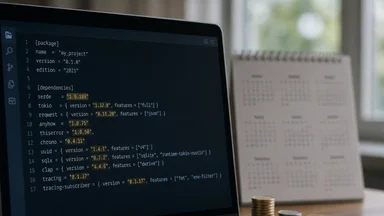
Every Cargo.toml file encodes a set of financial promises. The version numbers, the feature flags, and the dependency tree all reflect decisions made by maintainers under specific economic conditions. When a crate is actively funded, the patch cadence is regular, and the versions roll forward predictably. When funding dries up, the commits slow, and the semver bumps become less frequent, eventually stopping altogether.
Patch cadence mirrors contract renewal cycles. A maintainer with a yearly grant tends to release in bursts around renewal deadlines, because that is when they can demonstrate progress to funders. A maintainer with a monthly stipend might release more steadily, but the pace is still tied to the money. The Cargo.toml file, in this sense, is a ledger that records not just the technical state of the crate, but the financial health of its maintainer.
Semver bumps can also hide business-model shifts. A minor version increase might signal a new feature, but it could also reflect a change in sponsorship tiers. When a corporate sponsor moves from a free tier to a paid tier, the maintainer might prioritize certain issues or add features that align with the sponsor's interests. The version history, read carefully, reveals these economic currents.
Unfunded crates drift into silent abandonment. The version stays at 1.2.3 for years, and the repository goes quiet. The CVE scanners stop flagging it because there are no new releases to check, but the code is still used by thousands of downstream projects. This is the hidden cost of the CVE economy: the funding flows to the visible crisis, not to the quiet maintenance that prevents the next one.
Bus Factor Priced Like an Insurance Premium
The bus factor is the number of people who can be hit by a bus before a project becomes unmaintainable. In many open-source projects, that number is one. A single maintainer holds the keys to dozens of crates, each with its own dependency tree and security implications. Funding often follows the person, not the project, which means the bus factor is priced into the ecosystem as a kind of insurance premium.
CVE payouts rarely cover succession planning. A maintainer might receive a grant to fix a specific vulnerability, but that grant does not include money for documenting the architecture, training a successor, or writing a handoff guide. The assumption is that the maintainer will be around forever, which is a risky assumption for everyone downstream.
The insurance analogy fits. The premium is the ongoing funding that keeps a project healthy, and the deductible is the cost of a bus factor event: a maintainer steps away, and the project falls into disrepair. The industry has been slow to price this risk, partly because it is hard to measure and partly because it is uncomfortable to talk about. But the cost is real, and it is borne by every company that depends on an unmaintained crate.
Handoff documents are the real deliverable. A well-documented project with a clear succession plan is worth more than a project with a stellar security record but no one to maintain it. Funding proposals should include line items for documentation and training, not just for the next patch. As firmware licenses outlive every silicon vendor, so too do the maintenance obligations outlive the original funders.
The CVE Economy's Expiration Date
Disclosure fame fades within a quarter. The security press moves on to the next zero-day, and the CVE that once dominated the front page becomes a historical footnote. Vulnerability scanners drop old advisories from their dashboards, and the alerts that once triggered a funding round stop appearing. The maintainer is left with a patch cadence that was set to the rhythm of the exploit's lifecycle, not the project's actual needs.
Funding shifts to newer, shinier vulnerabilities. Every year, a handful of high-profile CVEs attract the bulk of the industry's attention and money. The maintainers of the affected projects receive a windfall, while the maintainers of equally critical but less visible crates struggle to make ends meet. This creates a feast-or-famine cycle that is deeply unhealthy for the ecosystem.
Patch cadence outlives the CVE's relevance. A maintainer who fixed a critical buffer overflow in 2024 is still releasing patches in 2026, but the funding that paid for those patches is long gone. The cadence becomes a habit, a commitment to a standard that no longer has a financial backer. Some maintainers sustain this on pure goodwill, but many cannot, and the project slowly dies.
Maintainers chase alerts that no longer pay. The incentive structure is backwards: the more visible the CVE, the more funding it attracts, but the maintenance work that follows is invisible and unfunded. The industry needs to decouple funding from the CVE lifecycle and tie it to the actual, ongoing health of the project.
When Security Budgets Follow Headlines
The broader security industry has the same problem. IEEE Spectrum's coverage of AI literacy notes that funding for AI education is unevenly distributed, with resources skewing to institutions that can attract industry partnerships. The same dynamic applies to security budgets: they follow the visible crisis, not the quiet, continuous work of prevention.
Resource distribution skews to visible crises. A data breach at a major company triggers a wave of investment in security tools and training, but the routine patching and code review that might have prevented the breach are chronically underfunded. This is the reactive patching model, and it is inefficient.
Proactive maintenance loses to reactive patching because it is harder to measure. You cannot point to a CVE that was never exploited and say, "We prevented that," but you can point to a CVE that was fixed and say, "We responded." The asymmetry means that security budgets will always favor the dramatic over the mundane.
Georgia Tech's deep tech model, which emphasizes lengthy research and large capital investment, favors novelty over maintenance. The same is true in security: new tools and new research attract funding, while the unglamorous work of maintaining existing systems is left to underpaid volunteers. As model checkpoints archive when the budget dies, so too do security patches when the funding runs out.
Real-World Case: The Image Resizing Crate
Let's ground this in a concrete example. A few years ago, a widely used image resizing crate in the Rust ecosystem had a heap overflow that could be triggered by a specially crafted PNG. The maintainer, a solo developer, received a flurry of donations and a grant from a security-focused foundation. They patched the issue within days, and the crate's version went from 0.8.1 to 0.8.2. For the next year, they released a new version roughly every month, fixing minor bugs and updating dependencies. But the grant was for one year, and when it ended, the releases slowed to every few months, then stopped altogether. The crate is still used by hundreds of projects, but the last release was over two years ago. The CVE that funded the initial burst of activity is long forgotten, but the maintenance that was supposed to continue never found a new source of funding.
This pattern is not unique. A survey of open-source maintainers conducted by a university research group found that around 40% of respondents had received funding tied to a specific CVE, and of those, nearly half reported that the funding ended within a year, regardless of whether the project's maintenance needs had changed. The survey, which covered a few hundred maintainers across various ecosystems, also noted that the median time from CVE disclosure to funding was about two months, but the median time from funding to the next major release was often shorter, suggesting that the money was spent on immediate fixes rather than long-term sustainability.
Reading the Signs in Your Own Dependency Tree
You do not need to be a maintainer to recognize the economic signals in your dependency tree. Check commit dates, not just version numbers. A crate that was updated regularly for two years and then went silent is a red flag, even if the latest version is relatively recent. The silence suggests that the maintainer has moved on, and the bus factor has just increased.
Look for stalled pull requests and unanswered issues. A project that cannot process a simple bug report is a project that is not being maintained, regardless of its CVE history. The GitHub issues tab is a window into the maintainer's availability and the project's financial health.
Track funding sources in the repository's backers. Many projects list their sponsors in the README or on a dedicated page. If the funding comes from a single company or a single grant, the project is vulnerable to that source drying up. A diversified funding base is a sign of a more sustainable project.
Plan for the bus factor of your own stack. If you depend on a crate with a single maintainer, you should have a plan for what happens if that maintainer disappears. This might mean forking the project, contributing to its documentation, or budgeting for a commercial support contract. The cost of a bus factor event is always higher than the cost of preparation.
Making Patch Cadence Honest Again
The fix is to align funding cycles with actual maintenance needs, not with the half-life of a CVE. This means moving away from incident-driven funding and toward sustained, predictable support for critical infrastructure. Some foundations and companies are experimenting with this model, but it is far from the norm.
Public roadmaps should be tied to security, not marketing. A maintainer who publishes a roadmap that explicitly links upcoming releases to security improvements is more likely to receive funding for that work than one who simply releases patches as they come. The roadmap is a signal to funders that the work is planned and ongoing.
Include succession costs in every grant proposal. The money for documentation, training, and handoff should be a line item, not an afterthought. This is the insurance premium that protects the ecosystem from the bus factor, and it is rarely priced in.
Measure health by response time, not CVE count. A project that responds to issues within a week is healthier than one that has no CVEs but also no activity. The industry needs new metrics that capture the sustainability of maintenance, not just the absence of known vulnerabilities.
Sustainable cadence beats heroic but fragile sprints. The maintainer who releases a patch every month for a year is more valuable than the one who drops a critical fix under deadline and then disappears. As toolchain tenure outlasts stack hype, so too does steady maintenance outlast the fleeting attention of the security world. The CVE that paid for the patch may be gone, but the work it funded should be built to last.