Redis Cluster Shards Outlive the Partition Algorithm That Placed Them
Redis Cluster's 16,384-slot design is often introduced as a pure partitioning scheme: keys hash to slots, slots map to nodes, and the cluster bus gossips ownership around. But that clean story stops at the moment of creation. Once shards exist, they develop a life of their own. Data accumulates, caches warm, and operators tune placement by hand. The partition algorithm becomes an origin story, not an ongoing guide.
When the Hash Ring Becomes the Bottleneck
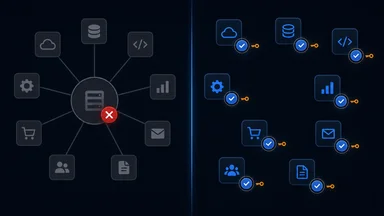
Consistent hashing was a quiet revolution in distributed storage. Instead of mapping keys directly to nodes, it mapped them to positions on a ring, so a node leaving only affected its immediate neighbors. Redis Cluster took a different route: a fixed grid of 16,384 slots. Each key hashes to a slot, and each slot belongs to exactly one node. The cluster bus, a gossip protocol over TCP, spreads slot ownership information to every node.
This design simplified a lot. Clients can cache the slot-to-node mapping locally, which keeps reads and writes fast. When a node moves slots, the cluster sends MOVED redirects to clients with stale caches, and the client re-fetches the map. Asynchronous replication means writes don't wait for a replica to acknowledge, so throughput stays high. Failover is automatic: a replica is promoted when its master fails, no external coordinator required.
But the hash ring mindset carries an assumption that the ring itself is the problem. A hash ring is a placement algorithm. Redis Cluster's grid is also a placement algorithm, and like any algorithm, it makes choices. Those choices happen once, at slot assignment time. The moment slots are assigned, the algorithm's job is done. What comes after, the actual life of the shards, is a different story.
The gap between theory and practice shows up in rebalancing. When a node joins or leaves, slots must be migrated. That is not a background process. It requires manual orchestration, often with redis-cli reshard, and it can pause or slow client requests. The cluster bus can lag under high churn, so slot ownership may be stale for a moment. The partition algorithm is only the initial placement, not an ongoing optimizer.
What Redis Cluster Actually Gets Right
Let's give credit where it's due. The slot-based design scales linearly. The 16,384-slot grid is large enough that adding a node means moving a few thousand slots, not rehashing every key. Clients cache the mapping, so most requests don't need a round trip to discover where a key lives. MOVED redirects handle the edge cases, and the cluster bus keeps nodes roughly in sync.
Asynchronous replication is a trade-off, but it's a deliberate one. Writes are acknowledged by the master before a replica confirms, which means a crash can lose a small window of data. For many workloads, that's acceptable. The alternative, synchronous replication, would add latency to every write. Redis Cluster picked speed, and it's been battle-tested in production for years.
Hash tags are a small feature with a big payoff. By wrapping a portion of a key in braces, you force those keys into the same slot. That enables multi-key operations like MSET or transactions across those keys. Without hash tags, multi-key operations would require cross-node coordination, which Redis Cluster deliberately avoids. Hash tags are a pragmatic escape hatch.
Failover is automatic and reasonably fast. When a master stops responding, the cluster detects it and promotes a replica. The promotion is not instant, but it's measured in seconds, not minutes. That's good enough for many services. The cluster also handles network partitions with a quorum-based approach, which is understandable and configurable.
Another often-underappreciated strength is the cluster's ability to handle slot migration with incremental copying. When you move a slot, Redis doesn't block the entire slot; it copies keys in batches and then switches ownership atomically. This means that a large slot can be migrated without a full stop-the-world pause, though it does require careful monitoring to avoid memory pressure from the temporary duplication. This design choice reflects a deep understanding of operational realities: migrations are not rare events, and they need to be as non-disruptive as possible.
Also, the cluster bus protocol is surprisingly efficient. It periodically exchanges small messages containing the cluster state, and it uses a binary format to keep overhead low. Even in clusters with dozens of nodes, the bus traffic is a tiny fraction of overall network usage. This allows the cluster to scale to hundreds of nodes without drowning in gossip, which is a common failure mode in other distributed systems.
Where the Algorithm's Assumptions Fray
The first crack appears with hot keys. A single key that gets hammered by millions of requests per second can saturate a node even if the rest of that node's slots are idle. The hash function distributes keys uniformly across slots, but access patterns are rarely uniform. Some slots become hot, others stay cold. The partition algorithm has no idea.
Large keys are another blind spot. A key holding a 100 MB value consumes memory and network bandwidth out of proportion to its slot. The hash function doesn't consider key size, so a few big keys can skew a node's resource usage. Operators often end up moving those keys manually, or splitting them into smaller pieces, which defeats the clean abstraction.
Resharding is the most visible fray. Moving slots between nodes requires copying data, and that copy can interfere with normal operations. The migration process is designed to be low-impact, but under heavy load it can still cause latency spikes. Operators learn to schedule resharding during low-traffic windows, but that's a manual ritual, not an automatic feature.
The cluster bus, which gossips slot ownership, can lag when nodes churn quickly. If a node crashes and a replica is promoted, the new owner must broadcast its slot map. Under rapid failover or network hiccups, that propagation can take longer than expected. Clients might see MOVED errors for a while, which they handle, but it adds noise.
Another assumption that frays is the uniformity of node capacity. The algorithm assumes all nodes are equal, but in practice you might have a mix of machines with different CPU, memory, and disk speeds. A slot that is migrated to a slower node can become a bottleneck even if it wasn't before. The algorithm doesn't account for heterogeneous hardware, so operators must manually adjust placement to match the actual performance profile of each node.
Also, the cluster's rebalancing is not self-optimizing. It doesn't monitor memory usage or CPU load across nodes and automatically move slots to balance them. The only automatic balancing happens when a node is added or removed, and even then it's a coarse-grained operation that moves a fixed number of slots without considering their actual size or access frequency. This means that over time, the cluster can become unbalanced in ways that are invisible to the algorithm but painfully obvious to the operator.
The Shards Outlive the Placement Logic
Here's the key insight: once a slot is assigned to a node, that shard accumulates data, builds up caches, and becomes part of the node's identity. When a node crashes, its replica takes over, but the shard itself doesn't move. The data stays on the same physical hardware, just under a different master. The hash function is long gone from the equation.
Operators quickly learn that they can override the algorithm. They can manually assign a hot slot to a dedicated node, or move a slot away from an overloaded one. The redis-cli reshard tool is clunky, but it works. Over time, a cluster's slot map becomes a hand-tuned artifact, reflecting operational wisdom rather than the original hash function.
Shard identity matters more than slot mapping. A shard is a unit of data locality. The caches on a node are warm for the slots it owns. Moving a slot means cold caches and a performance hit. So operators avoid moving slots unless they have to. The placement logic is a one-time event; the shard's life is what matters.
This decoupling is a feature, not a bug. The partition algorithm gets you started, but the system is designed to let you take over. The slot grid is a scaffolding, and the shards are the building. Over years of operation, a cluster's topology can diverge significantly from what the hash function would produce. That's fine, as long as the operators know what they're doing.
Consider a concrete example: a social media platform that uses Redis Cluster to cache user sessions. The initial deployment followed the default slot assignment, which spread sessions evenly. But as the platform grew, certain user segments became more active, and the slots holding those sessions became hot. The operators manually moved those slots to dedicated nodes with faster CPUs, and they also added more replicas for those slots to handle read traffic. Over time, the slot map looked nothing like the original hash distribution, but it was perfectly tailored to the actual workload. This is the norm in mature deployments, not the exception.
Another example comes from the e-commerce world. A large retailer uses Redis Cluster to store product inventory and pricing data. During holiday sales, certain product categories experience massive spikes in traffic. The operators pre-emptively move the slots for those categories to nodes with more memory and faster storage. They also use hash tags to keep related products in the same slot, enabling efficient multi-key operations. This manual intervention is essential to meet the performance requirements, and it demonstrates that the algorithm is just a starting point.
This longevity of shards has a profound implication: the cost of moving a shard is not just the data transfer, but also the loss of warm caches, the re-establishment of client connections, and the potential for increased latency during the migration. Therefore, operators should think of shards as strategic assets, not as interchangeable pieces. The placement decision made at the beginning is often less important than the decisions made later, when the shard's behavior is well understood.
Learning from a RISC-V Oberon Port
This pattern, where the original logic becomes obsolete but the artifacts persist, isn't unique to Redis. A recent Hacker News post showed a Project Oberon System running on RISC-V instead of the original RISC-5 architecture. Oberon, a small operating system and language from the 1980s, was designed for a specific processor. The port to RISC-V kept the kernel intact, but adapted it to a new environment.
The Oberon port is a reminder that software outlives its hardware. The original RISC-5 is gone, but the Oberon design survives because it's small and well-understood. The porting process exposed hidden assumptions, like the instruction set details, but the core logic remained. Shards are similar: the partition algorithm is the hardware spec, and the shards are the software that runs on top.
In the Oberon port, the reimplementation honored the original design rather than rewriting it. That's a lesson for operators. When a shard becomes a problem, the instinct might be to rehash everything. But that's expensive and risky. Instead, treat the shard as a durable entity and work with it, moving it carefully, or splitting it, but not discarding the placement logic wholesale.
The Hacker News thread showed genuine interest in the port, with only a few comments, but the project itself speaks to a broader truth. Legacy systems persist because they hold value. The same applies to shards. They accumulate data and locality, and that value is worth preserving, even when the original algorithm seems outdated.
The Oberon port also illustrates the importance of understanding the underlying architecture. The porters had to dig into the instruction set details, the memory layout, and the interrupt handling to make it work. Similarly, to effectively manage Redis Cluster shards, operators need to understand not just the high-level concept of slots, but also the low-level mechanics of how keys are stored, how replication works, and how the cluster bus communicates. This deep knowledge is what separates a competent operator from one who just follows the default configuration.
Moreover, the Oberon port shows that even a well-designed system can be adapted to new environments with careful thought. Redis Cluster is not a static system; it can be shaped to fit the needs of the application. The port's success was due to the porters' willingness to question assumptions and make targeted changes. Operators should adopt a similar mindset: question the default slot placement, experiment with different configurations, and be willing to deviate from the algorithm when it makes sense.
R&D Waste Mirrors Shard Stagnation
There's a parallel between shard stagnation and the R&D waste problem highlighted in a recent IEEE Spectrum report. The report notes that more than a third of organizations spend 25 to 40 percent of their R&D budget on projects that never reach market. Almost half of teams estimate over one million dollars in wasted investment per project killed during development or testing. AI adoption hasn't closed the gap.
Why do projects fail late? Often because they've accumulated technical debt and operational inertia. Teams avoid making changes because of risk, so they keep patching a system that should be rearchitected. That's exactly how stale shards behave. A hot shard could be split, but that requires careful planning and downtime, so operators tolerate the imbalance.
The IEEE report suggests that AI adoption has outpaced the intelligence needed to make good decisions. Similarly, Redis Cluster's slot grid is a smart algorithm, but it doesn't know about your access patterns. It's a tool, not a manager. The operator has to make the decisions, and those decisions are where waste creeps in.
Shards become legacy, like abandoned projects. They carry data that's hard to move, and they're intertwined with other systems. Rebalancing a cluster is a project in itself, with its own risks. So operators put it off, and the cluster drifts further from optimal. The partition algorithm is a distant memory, and the shards are the living reality.
The R&D waste report also highlights the emotional attachment to projects. Teams often resist killing a project because they've invested so much time and effort. Similarly, operators may resist moving a shard because they've grown accustomed to its behavior, even if it's causing problems. This sunk-cost fallacy can lead to prolonged performance issues that could have been avoided with a timely rebalance.
Another parallel is the lack of visibility. In R&D, projects often fail because there's no clear metric for success or failure. In Redis Cluster, operators often don't have good visibility into per-slot performance. They might know that a node is overloaded, but they don't know which specific slots are the culprits. This lack of observability makes it easy to defer action, just as vague project goals make it easy to defer killing a failing project.
To break the cycle of stagnation, both R&D teams and Redis operators need to establish clear review processes. For R&D, that means setting milestones and kill criteria at the start. For Redis, that means regularly reviewing slot maps and setting thresholds for when to rebalance. The report suggests that organizations that do this are more likely to succeed, and the same logic applies to cluster management.
Practical Takeaways for Operators
First, monitor per-slot access patterns. Redis doesn't expose per-slot metrics by default, but you can approximate by sampling keys or using the CLUSTER COUNTKEYSINSLOT command. Look for slots that are hot or have large keys. That's where the algorithm's assumptions break down.
Second, use hash tags to group related keys intentionally. If you know a set of keys will be accessed together, put them in the same slot. This reduces cross-node operations and helps with transactions. But don't overuse hash tags; they can create hot slots if not planned carefully.
Third, plan resharding during low-traffic windows. Slot migration is not free. It consumes network and disk I/O, and it can cause latency spikes. Schedule it when your load is lowest, and test the migration in a staging environment first. The redis-cli reshard tool is interactive, but you can script it.
Fourth, test failover before you need it. Redis Cluster's automatic failover is good, but it's not magic. Regularly kill a master in a test cluster and see how long the promotion takes. Make sure your client libraries handle MOVED and ASK redirects correctly. A failover test is a few minutes of work that can save hours later.
Fifth, document manual slot assignments. If you move a slot by hand, write it down. Future operators, including yourself in six months, will need to know why a slot is where it is. A simple comment in a config file or a README can prevent a lot of confusion.
Sixth, consider custom placement for hot shards. If a slot is consistently hot, you can move it to a dedicated node with more CPU or faster disks. That's a manual override, but it's a legitimate operational strategy. The algorithm didn't anticipate your workload, so you have to adapt.
Finally, evaluate your cluster topology periodically. The partition algorithm is a starting point, not a final answer. As your data grows and access patterns shift, the optimal placement changes. Set a reminder to review your slot map every quarter, and don't be afraid to make adjustments. Shards are long-lived, but they don't have to be permanent.
One additional practice that pays off is to simulate cluster changes in a test environment before applying them to production. This is especially important for complex migrations that involve multiple slots or nodes. Tools like redis-cli --cluster reshard can be used in a scripted fashion, but you should always dry-run the operation to catch any unexpected issues. This is similar to how you would test a database schema migration before running it on your primary database.
Another tip is to keep a history of slot migrations. This can be as simple as a text file with timestamps and reasons for each move. This history becomes invaluable when you're trying to understand why the cluster is in its current state, and it can help you identify patterns that might indicate a need for further rebalancing. It also helps in post-mortem analysis if something goes wrong.
Also, consider using the CLUSTER SLOTS command to get a snapshot of the current slot-to-node mapping. This is useful for debugging and for generating documentation. You can also use it to verify that your manual changes have been applied correctly. It's a simple command, but it gives you a clear picture of the cluster's topology.
Finally, remember that the goal is not to achieve perfect balance, but to achieve acceptable performance. Over-optimizing slot placement can lead to unnecessary churn and complexity. The key is to identify the few slots that are causing real problems and focus your attention there. This pragmatic approach is more sustainable than trying to make the cluster perfectly uniform.