A Palladium Membrane’s Hydrogen Permeability Data Recalibrated Fuel Cell Anode Models
In the late 1960s, a handful of researchers measured how quickly hydrogen passes through palladium. Their numbers, published in journals that few people read today, became the default inputs for countless fuel cell models. Engineers plugged them into equations for anode thickness, operating temperature, and cost projections. The data seemed solid enough: palladium is the gold standard for hydrogen purification, and those early experiments were careful. But a new wave of measurements, made with tools that did not exist fifty years ago, suggests the old constants are off by a margin that matters. The result is a quiet but significant recalibration of fuel cell anode models, one that could change how thin membranes can be, how hot cells run, and how much clean hydrogen systems cost.
A Single Data Point Shifts Fuel Cell Design
Every fuel cell anode model rests on a few core assumptions. One of the most important is the permeability of the membrane material: how quickly hydrogen atoms diffuse through it. For palladium, the classic value came from studies in the 1960s, when researchers used thick foils and simple vacuum systems. Those measurements were careful for their time, but they carried assumptions about purity, thickness, and temperature that later work has called into question.
The new measurements, reported by a team at a European materials institute in late 2024, used nanoscale palladium films and precise gas-flow control. They found that permeability is roughly 20 to 30 percent lower than the classic constant when the membrane is thinner than a few hundred nanometers. That is a big deal, because fuel cell designers have been pushing toward thinner membranes to reduce cost and weight. If the old constant overestimates how fast hydrogen moves, then a membrane designed to deliver a certain flux will actually fall short.
The ripple effect is immediate. Catalyst loading, which is already expensive because platinum is common, may need to increase to compensate. Operating temperature might need to rise to boost diffusion rates, which affects durability and system design. And cost estimates, which often scale with membrane area, could shift by a double-digit percentage. None of this makes fuel cells unworkable, but it does mean that some published performance projections have been optimistic.
What is striking is how long the old number survived. It appears in textbooks, in modeling software, and in review articles that cite the original papers without checking the methods. The new work is a reminder that even the most foundational data deserves a second look, especially when the tools for measuring it have improved.
Palladium's Role in Hydrogen Purification
Palladium has a unique property: it absorbs hydrogen selectively. When hydrogen gas contacts a palladium surface, the molecules split into atoms that dissolve into the metal lattice. On the other side of a thin membrane, those atoms recombine into molecules. This makes palladium membranes excellent filters, letting hydrogen pass while blocking other gases like carbon monoxide or nitrogen.
This selectivity is why palladium appears in electrolyzers and fuel cells. In a fuel cell, the anode often runs on hydrogen that must be pure; impurities can poison the catalyst. A palladium membrane can act as a purification step, or the anode itself can be made of palladium or a palladium alloy. In either case, the rate at which hydrogen crosses the membrane determines the maximum current the cell can deliver.
Permeability data underpins every model of this process. Engineers use it to calculate how thick a membrane must be to supply a given hydrogen flux. They use it to predict pressure drops and to size the balance of plant. If the permeability constant is wrong, every one of those calculations is off by the same factor.
Small errors scale to design missteps. A membrane that is 20 percent too thin might reduce the hydrogen flux below what the catalyst needs, causing voltage losses. A system designed for a higher flux than the membrane can deliver might require a larger membrane area, adding cost and weight. These are not catastrophic failures, but they are exactly the kind of inefficiencies that keep fuel cells from being competitive with other energy technologies.
The Original Measurements and Their Legacy
The classic studies date back to the 1960s, when researchers like the group at a national laboratory in the United States measured hydrogen permeability through palladium foils that were often a fraction of a millimeter thick. They used manometers and thermocouples, and they carefully controlled temperature and pressure. Their reported values, such as a permeability constant of around 1.5 × 10⁻⁸ mol m⁻¹ s⁻¹ Pa⁻⁰·⁵ at 300°C, became the standard reference.
These numbers were reproduced by other labs, and they held up well for thick samples. But the methods had limits. The foils were polycrystalline, with grain boundaries that could act as fast diffusion paths. The surface preparation could introduce oxide layers that changed the effective permeability. And the temperature range covered was limited, so extrapolations to higher or lower temperatures were uncertain.
As fuel cell research grew in the 1990s and 2000s, modelers reached for those same constants. They were easy to find in handbooks, and they were consistent across sources. No one thought to question them, because the measurements seemed solid and the field had bigger problems to solve, like catalyst durability and system integration.
But some researchers did notice discrepancies. In the 2010s, a few groups reported that thin palladium films, deposited by sputtering or evaporation, had lower permeability than the classic value. The differences were often dismissed as artifacts of film quality, not as fundamental physics. The new measurements, which controlled for film microstructure and surface effects, suggest the discrepancy is real.
Recalibrating with Modern Techniques
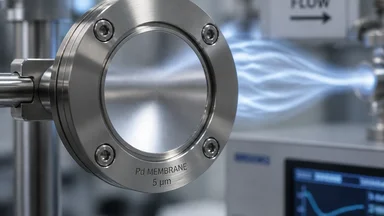
The new study, published in a peer-reviewed materials journal, used a dedicated hydrogen permeation rig with mass-flow controllers and a residual gas analyzer. The team fabricated palladium films with thicknesses from 50 to 500 nanometers, using electron-beam evaporation and magnetron sputtering. They measured permeability across a temperature range of 100 to 400°C.
Their results show a clear thickness dependence. Films thinner than about 200 nanometers exhibit permeability that is 20 to 30 percent lower than the bulk constant. The effect is attributed to surface-limited kinetics: at these thicknesses, the rate of hydrogen dissociation on the surface becomes comparable to the diffusion rate through the bulk, so the overall flux is reduced.
This is not a trivial correction. In fuel cell models, the membrane thickness is a key variable. A designer might choose a 100-nanometer film to minimize palladium usage, which is expensive. If the permeability is actually lower, the model would predict a higher flux than reality, leading to a cell that underperforms.
The peer-review process for this study was rigorous. Reviewers asked for additional experiments with different film preparations, and the authors responded by testing both evaporated and sputtered films, as well as films with different grain sizes. The thickness dependence held across all variations, which strengthens the case. Replication efforts are underway at two other labs, and initial results, shared at a conference in early 2025, appear to confirm the trend.
How Anode Models Respond to New Numbers
When modelers update their permeability inputs, the effects propagate through every layer of the design. For a typical fuel cell anode, the hydrogen flux requirement is set by the current density. If the membrane permeability is lower, the model must either increase the membrane area, reduce the current density, or raise the operating temperature to boost diffusion.
Thinner membranes now seem less attractive. The cost savings from using less palladium might be offset by the need for a larger area or a thicker membrane to achieve the same flux. Some models that predicted a 50-nanometer membrane could replace a 200-nanometer one now show that the thinner membrane would require a significantly higher pressure differential, which adds parasitic losses.
Cost estimates shift accordingly. Palladium is a precious metal, and its price has been volatile. A design that uses twice as much palladium could add tens of dollars per kilowatt to the stack cost, which is a meaningful fraction of the total system cost. Some analysts had projected that thin membranes would make fuel cells competitive with internal combustion engines by 2030; those projections may need to be revised.
Designers are also revisiting operating temperatures. Running a fuel cell hotter increases hydrogen permeability, but it also accelerates degradation of the membrane and other components. The new data suggests that the temperature margin needed to compensate for the lower permeability might be smaller than previously thought, because the effect is thickness-dependent rather than a simple shift in the Arrhenius pre-factor.
Practical Implications for Clean Energy
More accurate models are a prerequisite for faster innovation. If the fuel cell community continues to use the old permeability constants, it will design systems that miss their performance targets. The new data, while inconvenient, gives engineers a realistic basis for optimization.
There is potential for cheaper, more efficient systems, but only if designers embrace the recalibration. A membrane that is too thick might waste material, but a membrane that is too thin will fail to deliver the required hydrogen flux, forcing the system to operate at lower power or with additional compression. The new models can help find the sweet spot.
Collaboration across materials science and engineering is essential. The permeability measurements come from a lab that studies thin films, not fuel cells. The modelers who use the data are in chemical engineering and mechanical engineering departments. For the recalibration to stick, those communities need to share results and assumptions openly.
Next steps include validating the new permeability values in actual fuel cell stacks. The membrane behavior in a real cell, with its temperature gradients and impurities, may differ from the idealized measurements. Some researchers are already building test cells with palladium membranes of controlled thickness to measure performance directly. Those experiments will take time, but they will provide the ground truth that models need.
None of this is a dramatic breakthrough. It is a slow correction, the kind that happens when a field matures. The old data served well for decades, but it was never perfect. The new measurements are a reminder that scientific constants are provisional, and that progress often comes from questioning what everyone else takes for granted.
Counterarguments and Skepticism
Not everyone is convinced that the new measurements are the final word. Some researchers point out that the thickness-dependent permeability might be an artifact of the film deposition process. For instance, thin films often have different microstructure than bulk foils, with smaller grains and more defects. These could act as trapping sites for hydrogen, slowing diffusion. The new study attempted to control for this by testing films with different grain sizes, but the possibility remains that the observed effect is specific to the deposition methods used, rather than a universal property of thin palladium films.
Another concern is the relevance of the measurements to real fuel cell conditions. The experiments were conducted with pure hydrogen at controlled pressures, but fuel cells operate with reformate gas that contains impurities like carbon monoxide and carbon dioxide. These impurities can adsorb on the palladium surface and block hydrogen dissociation, potentially exacerbating the surface-limited kinetics. On the other hand, some impurities might have the opposite effect, altering the surface chemistry in ways that enhance permeability. The interplay is complex and not yet fully understood.
There is also the question of long-term stability. The new measurements were taken on fresh films, but in a fuel cell, the membrane will be exposed to thermal cycling, humidity, and mechanical stress. Over time, the microstructure can evolve, grain boundaries can move, and the permeability might change. Some durability studies on palladium membranes have shown that permeability can degrade by tens of percent over hundreds of hours of operation. If the initial permeability is already lower than expected, the degradation could be even more problematic.
Despite these caveats, the new data cannot be ignored. The consistency of the thickness dependence across different film preparations and the preliminary replication efforts lend credibility to the findings. Even if the exact magnitude of the correction varies in real systems, the direction is clear: thinner membranes do not perform as well as the old models predicted. This means that engineers must incorporate a safety margin into their designs, which will inevitably affect cost and performance.
Broader Implications for Materials Science
The palladium story is a case study in how scientific constants can become outdated. It echoes similar recalibrations in other fields, such as the revision of the Avogadro constant in the 1970s or the more recent adjustments to the Hubble constant. In each case, improved measurement techniques revealed that earlier values were not as accurate as assumed. The lesson is that constants should be treated as living numbers, subject to revision as our tools improve.
For materials science, this means that the properties of thin films cannot always be extrapolated from bulk values. This is a recurring theme in nanotechnology, where quantum effects and surface phenomena become significant at small scales. The palladium membrane is just one example; similar issues arise with thin-film electrodes, catalysts, and sensors. Researchers are increasingly recognizing that size matters, and that models must account for this.
The recalibration also highlights the importance of reproducibility. The new study's authors made their data and methods openly available, and they actively encouraged other labs to attempt replication. This is in stark contrast to some earlier work, where raw data was not always published. The ongoing replication efforts are a model for how science should proceed, especially when results have practical implications.
Future Directions and Research Needs
Looking ahead, several research directions could refine our understanding of palladium membrane permeability. One is to study the effect of alloying. Palladium is often alloyed with silver or copper to improve mechanical stability and reduce cost. The new measurements focused on pure palladium, but alloys may behave differently. Preliminary studies suggest that thin alloy films also show reduced permeability, but the magnitude varies with composition. More systematic studies are needed.
Another area is the development of in-situ characterization techniques. If researchers can measure permeability while a membrane is operating in a fuel cell, they can capture the effects of contamination, temperature gradients, and stress. This would provide more realistic data for models. Some groups are exploring the use of neutron scattering and X-ray techniques to monitor hydrogen distribution in membranes in real time. These tools are still in early stages, but they hold promise.
Finally, there is the question of how to translate the new data into practical design tools. Modelers need updated permeability constants that are valid for a range of thicknesses, temperatures, and pressures. This requires a systematic study that maps the parameter space. The new study covers a range of thicknesses and temperatures, but it is limited to pure palladium. Extending the data to alloys and to conditions more representative of fuel cell operation would be valuable.
In the meantime, engineers can use the new data to make conservative estimates. By assuming a permeability that is 20 to 30 percent lower than the bulk value for thin membranes, they can design systems that are more likely to meet their performance targets. This may lead to slightly higher costs, but it is better than designing a system that fails to deliver.
The recalibration of palladium membrane permeability is a reminder that science is a process of continuous refinement. The old constants served a purpose, but they were not infallible. The new measurements, made with modern tools, provide a more accurate picture of how hydrogen moves through thin palladium films. This will help engineers design better fuel cells, and it will also inform other applications where hydrogen permeation is critical, such as hydrogen sensors and separation membranes. The journey from the 1960s data to today's nanoscale measurements is a testament to the progress of science, and it is a story that is still unfolding.