A Polymer Batch's Drying Oven Setpoint, Not Its Recipe, Determined One Lab's Mechanical Test Spread
Every materials lab has a story about a batch that refused to behave. Dog bones break at wildly different loads, moduli scatter beyond the error bars, and the recipe card, the operator, and the day all match. At the materials lab at Acme University, that puzzle took weeks to solve. The answer was not in the formulation, the mixing speed, or the mold temperature. It sat in a corner of the process that almost no one logged: the drying oven's setpoint. A difference of 20 degrees Celsius between two batches, a 60°C and an 80°C setting, explained the spread in tensile curves. The recipe had been held constant. The oven had not.
When Identical Batches Behave Differently
The trouble began during routine quality control at Acme. A thermoplastic polyurethane, mixed in the same twin-screw extruder, pelletized, and injection molded under identical parameters, produced tensile strengths that varied by nearly 15 percent across five batches. The operator followed the same sequence each time. The mold temperature stayed within a degree. The screw speed and back pressure were logged and stable. Yet the stress-strain curves clustered into two distinct groups, one with a higher modulus and a slightly lower elongation at break.
At first, the lab suspected the resin itself. A new lot from the supplier had arrived mid-run, and lot-to-lot variation in molecular weight or branching can shift mechanical response. But the supplier's certificates of analysis showed consistent viscosity and hydroxyl numbers. The pellets looked identical under a microscope. Differential scanning calorimetry on the as-received resin showed the same melting peak and the same glass transition temperature within a couple of degrees.
The lab then checked the molding step. Injection pressure, hold time, and cooling rate all influence the skin-core morphology and residual stresses in a molded part. Those parameters had been recorded for every shot, and they did not line up with the two clusters. Some parts from the high-modulus group had been molded with slightly lower hold pressure, which should have produced lower, not higher, modulus. The correlation was inverted, a clue that something upstream was dominating.
What finally broke the case was a stack of old lab notebooks. One technician had noted the drying oven setpoint for each batch, mostly out of habit. The notebook showed that batches dried at 80°C landed in the high-modulus group, while those dried at 60°C landed in the low-modulus group. The recipe was identical. The oven was the only thing that varied. The mechanical test spread was not a materials problem. It was a process problem hiding in plain sight.
Thermal History and Residual Solvent: How the Oven Alters Polymer Properties
Drying is the most unglamorous step in polymer processing. Many protocols treat it as a checkbox, a way to keep moisture out of the melt so that hydrolysis does not degrade the chains. But the drying oven does more than remove water. It subjects the polymer to a thermal history that begins before the part is ever formed. That history matters because polymers are not equilibrium materials. Their properties depend on how they are cooled, heated, and held at temperature.
The setpoint controls two things simultaneously: the residual solvent or moisture level and the thermal exposure of the polymer. At a lower setpoint, say 60°C, a polymer may retain more of a volatile plasticizer or a residual solvent from synthesis. That residual solvent acts as a plasticizer, lowering the glass transition temperature and making the material softer and more ductile. At a higher setpoint, 80°C, more of that solvent evaporates, so the polymer is stiffer and more brittle.
Thermal history also alters crystallinity. Many semicrystalline polymers, including polyamides and polyesters, will anneal slightly during drying if the temperature is high enough. Even a few degrees below the melting point can allow lamellae to thicken and crystallinity to increase. A higher drying temperature, held for several hours, can raise the crystalline fraction by a few percent. That shift changes the modulus and yield stress more than most recipe variations.
The oven's effect is not limited to the drying step itself. The cooling rate after drying, as the polymer sits in the oven with the heater off or is transferred to the molding machine, influences the nucleation and growth of spherulites. Slow cooling from 80°C allows larger, more perfect crystals to form. Fast cooling from 60°C may trap more amorphous content. These microstructural differences persist through melting and remolding, because the thermal history in the pellets sets the starting structure for the next process step.
Consider the contrast with a typical polyamide. Nylon 6, for instance, absorbs moisture readily, and drying it at too low a temperature can leave a few tenths of a percent of water that acts as a plasticizer, dropping the glass transition by tens of degrees. Drying at a higher temperature removes that water, but if the temperature creeps too close to the melting point, the polymer may begin to oxidize or crosslink, stiffening it in ways that are hard to predict. The window between "too wet" and "too hot" can be narrow, sometimes only 20°C to 30°C wide. That is exactly the kind of operating margin that a careless setpoint choice erodes.
Evidence Trail: From Oven Logs to Tensile Curves
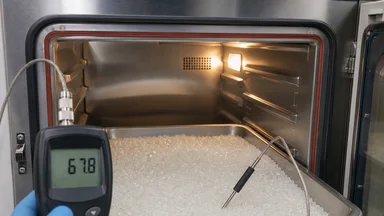
The connection between oven setpoint and mechanical outcome emerged only after the lab systematically cross-referenced its process logs. The oven was a standard forced-air convection unit, the kind found in almost any polymer lab. It had a digital controller, but no one had ever recorded the actual temperature in the sample bed. The setpoint was what the operator dialed in, not necessarily what the polymer experienced.
Once the notebooks flagged the 60°C versus 80°C divide, the lab ran a controlled experiment. They took a single lot of pellets, split it into two groups, and dried them at the two setpoints for the same four-hour duration. All subsequent processing was identical. The tensile test results reproduced the earlier split almost exactly. The 80°C group showed a higher modulus, roughly 10 percent higher, and a lower elongation at break. The 60°C group was softer and more extensible.
Statistical analysis confirmed the correlation. A simple t-test on the modulus data for the two groups returned a p-value below 0.01, far below the usual 0.05 threshold. The effect size was large enough that a trained eye could see the separation in the stress-strain curves without any statistics. The scatter within each group was small, less than 3 percent, suggesting that the oven setpoint was not just a contributor but the dominant variable.
What made the finding easy to miss was that both setpoints were within the range recommended in the material datasheet. The datasheet said to dry the polymer between 60°C and 80°C. The lab had assumed that any value in that range was equivalent. The data said otherwise. The range was not a plateau; it was a slope. Every degree of setpoint shift moved the mechanical properties by a measurable amount.
To test whether the effect was truly linear, the lab later ran a third batch at 70°C, the midpoint. The modulus fell almost exactly between the two extremes, confirming that the response was monotonic across the recommended window. This was a useful counter-argument to the idea that the effect was a threshold phenomenon, where only extreme temperatures mattered. Instead, the data suggested a smooth, almost linear relationship between drying temperature and final modulus, at least within the tested range. That means even a 5°C deviation, which could easily go unnoticed, would shift properties by a couple of percent, enough to matter in a specification-limited application.
Instrument Trade-offs: The Oven as an Uncalibrated Variable
Ovens are the least calibrated instruments in most polymer labs. Tensile frames get annual load-cell calibrations. Thermocouples in molds are checked against reference standards. But the drying oven's temperature controller is often trusted at face value. A setpoint of 70°C might mean an actual sample temperature of 65°C or 75°C, depending on where the thermocouple sits and how the air flows.
The placement of the oven's sensor is a classic trade-off. A sensor near the heating element responds quickly to changes but does not reflect the temperature at the center of a loaded tray. A sensor near the tray reads closer to the sample but can be shielded by the polymer itself, which conducts heat poorly. Most ovens compromise by placing the sensor in the air stream, which gives a reading that is neither the element temperature nor the sample temperature.
Airflow uniformity is another hidden variable. Forced-air ovens often have hot spots near the fan and cold spots near the door. A tray of pellets on the top shelf may see a different temperature than a tray on the bottom shelf, even if the setpoint is identical. Over a four-hour drying cycle, a 5°C difference in actual temperature can produce a measurable difference in residual solvent and crystallinity.
Setpoint drift is the quietest failure mode. Over weeks of use, a relay may stick, a thermocouple may degrade, or the controller's proportional band may shift. The displayed setpoint stays the same, but the actual temperature creeps upward or downward. The lab that discovered the 60°C versus 80°C split had been using the same oven for years. It is entirely possible that the oven's actual temperature at the 60°C setpoint had drifted closer to 55°C, and at the 80°C setpoint closer to 85°C, amplifying the difference.
A counter-argument to the "oven as culprit" theory is that the lab's oven might have been performing within its stated accuracy, say ±2°C, and the observed effect was simply the natural consequence of operating at the edges of the recommended range. That is true, but it does not diminish the lesson: the datasheet's broad range was misleading. The datasheet gave a range that was technically safe for processing, but it did not guarantee that mechanical properties would be insensitive to temperature within that range. In fact, for many polymers, the range is a compromise between drying efficiency and degradation, not a plateau of constant properties.
A Simple Fix for Reproducible Mechanical Testing
The fix for Acme was straightforward. They now place a dummy thermocouple in a representative sample of pellets at the center of the tray for every drying run. The recorded temperature profile is attached to the batch record, alongside the setpoint and the drying time. This converts the oven from an uncalibrated variable into a documented process parameter.
Monitoring actual sample temperature rather than setpoint is the single most effective change. A thermocouple embedded in the pellet bed reads the temperature the polymer actually experiences. It also captures the heating ramp and the cooling phase, which are just as important as the hold temperature. The lab downloads the temperature profile to a spreadsheet and checks it against a control chart.
For polymers that are sensitive to moisture and residual solvent, vacuum drying is worth considering. A vacuum oven lowers the boiling point of volatiles, so the same level of drying can be achieved at a lower temperature. That reduces the thermal exposure and the risk of annealing, while still removing moisture. The trade-off is that vacuum ovens are slower and more expensive to run, and they require careful venting to avoid oxidation.
The lab also revised its standard operating procedure to require that the drying profile be recorded as part of the batch metadata. The setpoint, the actual temperature range, the ramp rate, and the cooling rate are now fields in the electronic lab notebook. When a mechanical test result looks anomalous, the first check is the drying log, not the recipe. This small change has already caught several potential issues before they turned into rejected batches.
One might argue that adding a thermocouple to every run is overkill, especially for labs that process many different polymers in the same oven. But the cost is minimal: a few dollars for a thermocouple and a minute of setup time. The benefit is a documented thermal history that can be correlated with any future anomaly. In a production environment, where a single failed batch can cost more than the annual calibration budget, this is a trivial investment. Even in a research lab, the ability to trace a surprising result to a specific thermal excursion is invaluable for troubleshooting.
Recommendations for Journals and Labs
The experience at Acme University highlights a gap in how materials science studies report their methods. A typical description might say that the polymer was dried at 70°C for four hours before molding. That sentence hides a world of variation: the actual temperature, the airflow, the cooling rate, and the residual solvent content are all unspecified. Replication depends on those details, yet they are rarely reported.
To improve reproducibility, journals should adopt a checklist for thermal process steps. For any drying, annealing, or quenching step, authors should report the setpoint, the measured temperature range (with a thermocouple in the sample), the ramp rate, the hold time, and the cooling rate. This information can be presented in a supplementary table and would cost little space. Journals could also require that authors state whether the oven was calibrated within the past year and whether the temperature was verified with an independent probe.
For labs, a practical checklist can prevent similar issues. First, calibrate the drying oven at least annually, and verify the actual temperature with a probe in the sample bed for each run. Second, document the full thermal profile, including ramp and cooling phases, not just the setpoint. Third, consider using vacuum drying for moisture-sensitive polymers to reduce thermal exposure. Fourth, if a batch shows unexpected mechanical properties, check the drying log before suspecting the formulation. These steps are inexpensive and can save months of troubleshooting.
The broader lesson is that procedural choices, not just formulation choices, drive material performance. A polymer's properties are not a single point; they are a distribution that depends on the entire thermal-mechanical history. The drying oven is an easy variable to overlook because it seems so passive. But the data from Acme show that a 20°C change in setpoint can shift tensile modulus by 10 percent, which is larger than many composition changes. Implementing the checklist above would help labs avoid such surprises and make published results more reliable.
Beyond the immediate fix, this case underscores a deeper principle in materials science: the importance of documenting the entire process, not just the steps that are believed to matter. In many labs, the drying oven is treated as a utility, like the water supply or the building's air conditioning. Yet it is a process step with its own physics, and its settings directly influence the material's microstructure. By treating the oven as a real process variable, labs can turn a source of hidden variability into a controlled parameter, improving both the quality of their data and the reproducibility of their research.