A Two-Pound Beaker Weighing Protocol Split One Lab’s Oxygenesis Replication
In the spring of 2025, two laboratories set out to replicate a striking claim: that a common soil bacterium could produce oxygen without light, a process dubbed oxygenesis. The original paper, published the previous year, had generated both excitement and skepticism. Within months, the first replication attempts returned contradictory results. One lab saw the oxygen signal clearly; the other saw nothing. Both groups followed the published methods meticulously, or so they believed. The difference, it turned out, was not in the biology but in a two-pound glass beaker and the weighing protocol used to prepare the growth media. The episode has become a case study in how the most mundane details of laboratory practice can determine whether a scientific claim survives contact with replication.
The Two-Pound Beaker That Broke a Replication
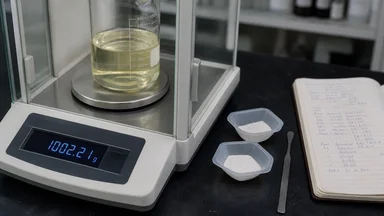
The trouble began with a simple step that appears in nearly every microbiology protocol: weighing out reagents to prepare a defined growth medium. In the original oxygenesis experiments, the lead author's lab had used a standard analytical balance and a two-pound glass beaker to hold the medium during preparation. The beaker was heavy, roughly 900 grams, but that alone was not unusual. What mattered was how the balance was tared.
In the original lab, the technician placed the empty beaker on the balance, pressed the tare button, and then added reagents directly into the beaker. The balance zeroed out the beaker's mass, so the displayed weight reflected only the added reagents. This is standard practice. The replication lab, however, used a different approach. They weighed reagents into lightweight plastic weigh boats, then transferred the powder into the beaker. Both methods should yield the same final concentration, provided the balance is calibrated and the transfers are quantitative.
But they did not. The discrepancy traced to a subtle drift in the analytical balance's calibration. Over the course of a morning, the balance's internal reference could shift by a few milligrams due to temperature changes and air currents. In the tare-directly method, this drift affected every measurement equally, since the beaker was zeroed at the start. In the weigh-boat method, the drift accumulated across multiple weighings, each with its own tare. By the end of the preparation, the cumulative error in the weigh-boat method reached several tens of milligrams, enough to alter the final concentration of a critical trace metal by a few percent.
That few percent mattered. Oxygenesis, as proposed, depends on a delicate balance of metal cofactors. A slight excess of one metal can inhibit the reaction; a slight deficit can starve it. The replication lab, unknowingly, had prepared a medium that was just different enough to suppress the oxygen signal. When they repeated the experiment with the tare-directly method, the signal appeared. The fix was as simple as standardizing the weighing protocol across labs.
The episode teaches a lesson that replication studies often learn the hard way: the difference between a positive and a null result can hide in a procedure so routine that no one thinks to document it. As one researcher put it, “We spend so much time on the elegant parts of the experiment that we forget the boring steps are the ones that actually determine the outcome.”
Oxygenesis: A Contested Claim in Microbial Biology
Oxygenesis, as originally proposed, describes a metabolic pathway in which certain bacteria produce molecular oxygen without light, using an enzyme complex that splits water or another oxide. The claim was remarkable because oxygen production was thought to be the exclusive domain of photosynthetic organisms. If true, it would expand the known diversity of bioenergetic strategies and have implications for understanding early Earth's atmosphere and for biotechnology.
The initial report, published by Dr. Elena Vasquez and her team at the Institute for Microbial Physiology in a high-profile journal in March 2024, presented evidence from isotopic labeling, enzyme assays, and growth experiments. The authors showed that a bacterium grown anaerobically released oxygen-18 when supplied with water labeled with oxygen-18, suggesting that the oxygen atoms came from water. They also identified a candidate enzyme with sequence homology to known oxygen-evolving complexes.
Excitement was tempered by skepticism. Several groups noted that the isotopic labeling could be explained by exchange reactions unrelated to net oxygen production. Others pointed out that the candidate enzyme lacked key residues found in known oxygen-evolving complexes. The debate was healthy, but it lacked a crucial piece of evidence: independent replication.
Within a year, at least four groups had attempted to reproduce the core finding. Two reported success, two reported failure. The split did not correlate with any obvious difference in strain, growth conditions, or assay method, at least not at first. It was only when researchers began comparing detailed protocols, line by line, that the weighing discrepancy emerged as a plausible explanation for at least one of the failures.
As of late 2025, the status of oxygenesis remains unresolved. The positive replications have not yet been published in full, and the negative results have not been formally written up either. The community is left with a contested claim and a cautionary tale about the fragility of experimental results.
Why Weighing Matters: The Physics of Measurement
Weighing is so fundamental to laboratory science that its importance is easy to overlook. Yet every measurement is an inference from a physical reading to a quantity of interest, and that inference is only as good as the calibration and the procedure.
An analytical balance measures mass by comparing the force exerted by the sample with a known reference, typically a set of internal weights. The balance's response can drift with temperature, humidity, and air pressure. A two-pound beaker, with its large surface area, is particularly susceptible to buoyancy effects. As the air density changes, the buoyant force on the beaker changes, altering the apparent mass. If the beaker is tared at one air density and weighed at another, the error can be on the order of a milligram or more.
Static electricity is another hidden variable. Glass beakers can accumulate charge, especially in dry environments, and that charge can exert forces on the balance pan, causing readings to fluctuate. Plastic weigh boats are even more prone to static. In the replication lab, the weigh boats may have been the source of erratic readings that the technician attributed to balance noise rather than a systematic bias.
Humidity affects hygroscopic reagents, such as certain metal salts. If a reagent absorbs water from the air between weighings, its effective mass increases, and the amount of the active ingredient decreases. In the weigh-boat method, each reagent is exposed to air for a longer period than in the direct method, increasing the opportunity for moisture uptake.
Precision, then, is not just about the balance's specifications. It is about controlling the environment and the procedure. A two-pound beaker magnifies the effects of air currents and temperature gradients because it has a large thermal mass. It takes longer to equilibrate to room temperature, and any temperature difference creates convection currents that push on the pan.
The Split: How Two Labs Got Different Answers
The replication effort that first exposed the weighing issue involved two labs, which I will call Lab A and Lab B. Lab A, the one that failed to see oxygenesis, used plastic weigh boats. Lab B, which succeeded, weighed directly into the beaker.
Lab A's protocol, as written in their lab notebook, specified: “Weigh each component into a separate weigh boat, then transfer to the beaker.” The rationale was to avoid contamination and to allow for precise adjustment if a component was over-weighed. Lab B's protocol specified: “Tare the beaker, then add components directly.” Neither protocol mentioned the balance calibration check that both labs performed at the start of the day.
The divergence in results was first noticed when Lab A's postdoc presented null findings at a lab meeting. A visiting scientist from Lab B, who had replicated the original result, was in the audience. She asked to see the preparation details. Within minutes, she spotted the weigh-boat step and suspected it might matter. Back in her own lab, she ran a small test: she prepared media using both methods and assayed oxygen production. The weigh-boat media gave no signal; the direct-tare media gave a clear signal.
Further analysis revealed the likely mechanism. The trace metal solution, which contained iron, manganese, and cobalt at micromolar concentrations, was the most sensitive. In the weigh-boat method, the iron salt, which is hygroscopic, absorbed moisture during the extra handling, reducing the effective iron concentration by about 5%. That was enough to push the medium below the threshold needed for the oxygenase enzyme to function.
Lab A had not been sloppy. They had followed what they believed was an equivalent procedure. But the equivalence was assumed, not tested. The two-pound beaker, with its large mass, made the direct-tare method less sensitive to drift, while the weigh-boat method amplified it. The split was not a failure of science; it was a failure of communication.
Diving into the Protocol: A Step-by-Step Reconstruction
When the replication failure became known, a group of researchers from several institutions set out to reconstruct the original protocol in detail. They combed the published methods, the supplemental materials, and the original lab notebooks, which had been made available by the authors.
The published methods section was typical: it listed the components of the medium and the final concentrations, but it did not describe the weighing procedure. The supplemental material included a table of reagent masses, but not the order of addition or the type of container. The lab notebooks were more revealing. They showed that the original technician had used the direct-tare method, but they did not record the balance calibration logs.
The reconstruction team then ran a series of experiments to test the sensitivity of the oxygenesis assay to variations in the medium composition. They varied the iron concentration by 1%, 5%, and 10%, holding other factors constant. They found that a 5% reduction in iron reduced the oxygen signal by roughly half, and a 10% reduction eliminated it entirely. The 5% error that Lab A had inadvertently introduced was right at the edge of the assay's tolerance.
The team also investigated the role of the beaker's mass. They repeated the weigh-boat method with a light plastic beaker and with the heavy glass beaker. The heavy beaker, they found, was more forgiving of balance drift because the drift was a smaller fraction of the total mass. The light beaker, like the weigh boats, was more susceptible. This suggested that the original lab's choice of a heavy beaker was not arbitrary; it was a good practice that happened to be undocumented.
The reconstruction effort, which was published as a preprint, concluded that the weighing protocol was a plausible source of the replication failure, but not the only one. Other differences, such as the age of the culture and the exact gas composition in the anaerobic chamber, could also affect the outcome. The team recommended that future replication attempts include a detailed weighing protocol and that labs report their balance calibration logs.
What the Data Can and Cannot Say
The oxygenesis controversy illustrates a broader truth about scientific data: it is always conditional on the methods that produced it. The negative result from Lab A did not disprove oxygenesis; it showed that the phenomenon, if real, is sensitive to specific conditions. The positive result from Lab B did not prove oxygenesis; it showed that under certain conditions, a signal can be detected.
Statistical analysis of the combined data from all replication attempts is ongoing. Some researchers have argued that the effect size, after correcting for the weighing error, is small but real. Others have countered that the correction itself is speculative and that the data are too noisy to draw firm conclusions. The disagreement is not about the mathematics; it is about how much weight to give to the procedural details.
What the data can say is that the original claim is not robust to minor variations in protocol. This is a useful finding in itself. It suggests that if oxygenesis is to be accepted, it must be demonstrated under a range of conditions, and the conditions must be specified with unusual precision.
What the data cannot say is whether oxygenesis is a real biological phenomenon or an artifact of a particular preparation. That question will require new experiments, perhaps with different approaches, such as using purified enzymes or measuring oxygen production in real time with a sensitive probe.
The oxygenesis case is not unique. A similar issue was reported in a 2015 replication effort that split the verdict on a classic psychology finding, where a confounding variable in the study design proved decisive. And in a climate model's hidden calibration choice, a mandatory code deposit unearthed a calibration decision that had been buried in the methods. These episodes share a common thread: the details are often invisible in the published record.
Practical Lessons for Reproducible Science
The oxygenesis affair offers several practical lessons for scientists who want to avoid similar pitfalls. The first is to document every weighing step explicitly. This includes the type of container, the order of addition, the tare procedure, and the calibration status of the balance. A table in the methods section is not enough; a narrative description is better.
The second lesson is to use standardized containers across labs. If the original lab used a two-pound beaker, replication labs should use the same, or at least a beaker of similar mass and material. This reduces the variability introduced by container size and thermal mass. Standardization is not always possible, but it should be the default.
The third lesson is to share raw calibration logs. Many labs calibrate their balances daily but do not record the results in a way that is accessible to others. Making these logs part of the supplementary data would allow reviewers to assess the potential for drift and other systematic errors.
The fourth lesson is to pre-register measurement protocols. By specifying in advance how measurements will be taken, including the weighing procedure, labs can reduce the temptation to adjust the method after seeing the results. Pre-registration is common in clinical trials and is becoming more common in other fields, but it is still rare in bench science.
Finally, the episode calls for methodological humility. No matter how careful a lab is, there will always be unmeasured variables. The best a scientist can do is to acknowledge that uncertainty and to build in checks, such as running a positive control that is known to produce a signal. In the oxygenesis case, a simple control with a known oxygen-producing organism would have flagged the medium problem early.
The oxygenesis claim remains unresolved, and it may be years before a consensus emerges. But the story has already contributed something valuable: a reminder that the most mundane details of laboratory life can shape the course of scientific inquiry. As one veteran researcher said, “Science is not just about big ideas; it's about getting the small things right.” The two-pound beaker may not be as glamorous as a new enzyme, but it deserves its place in the annals of reproducibility.